The death of software or the rise of ultra-niche software
With AI, you start from what you want and it produces a surprisingly good implementation. For many things you get a one-shot result already.
A few months ago I was doubtful about AI capabilities. It is only going to get better over the next few months.
People are now building open-source versions of large software - the full Adobe ecosystem with PDF, Photoshop, After Effects, and full Microsoft-style systems with Word, Excel, everything. People call this the death of software.
Is it the death of software? As a developer, I know things keep coming up. The faster people develop, the more mistakes they make. Right now people do not even read the code they ship.
The counterargument is that if AI writes code, it can also fix issues faster. That is true in part. But new bottlenecks are emerging, like code reviews. New paradigms are emerging too, like auto-verification, where machines review machine-written code. It is yet to be seen how that pans out. Unless a codebase has been really peer-reviewed, AI can leave blind spots that come up later. The ease of code will most likely increase our wants proportionally - humans are never satisfied after all.
What will change is the numbers. We may not need so many people writing software because the leverage with AI is immense. One person doing the right thing can create orders of magnitude of leverage. The numbers will reduce, and we can see that across the board.
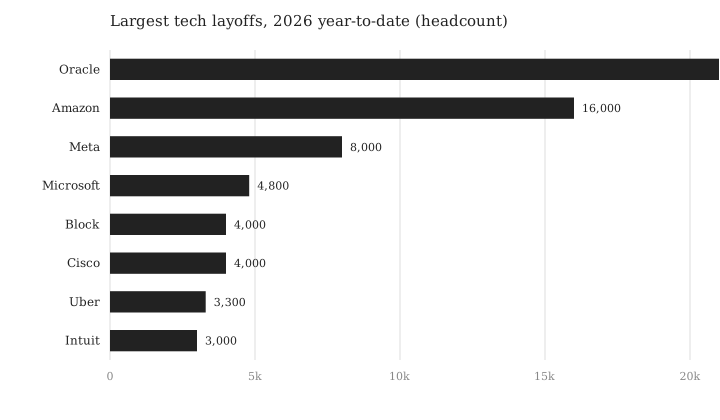
The cuts so far in 2026, by headcount:
The same cuts as a share of workforce - this is the developer-strength part:
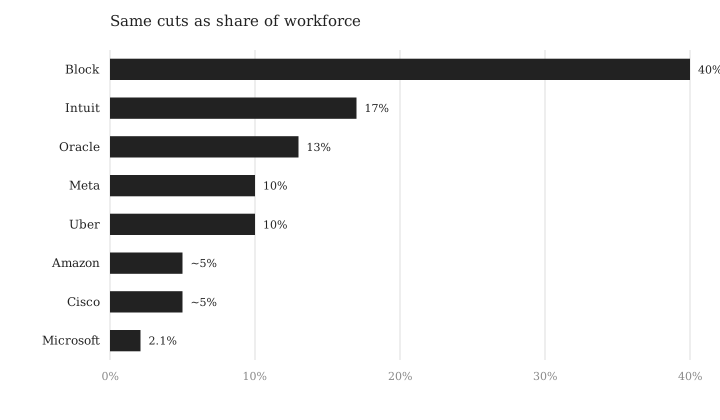
Treat both charts as approximate. Trackers disagree because they count different things. Layoffs.fyi via TradingView counted 128,536 workers across 299 companies through September 10, 2026, already above 122,606 across 278 companies in all of 2025. Crunchbase counted 94,046 US tech layoffs from January to August 2026, up from 80,486 in the same period of 2025. Company numbers above are the disclosed rounds: Oracle about 21,000 over the past year, down from 162,000 to 141,000 full-time employees; Amazon 16,000 corporate roles in January after 14,000 in October 2025; Meta about 8,000 in May; Microsoft 4,800 in July; Block over 4,000; Cisco just under 4,000; Uber 3,300; Intuit 3,000. Shares are each round against the company headcount at the time: Block 40%, Intuit 17%, Oracle about 13%, Meta 10%, Uber 10%, Amazon about 5% of corporate, Cisco about 5%, Microsoft 2.1%. Sources: Crunchbase 2026 layoffs, Layoffs.fyi via TradingView, InformationWeek tracker, WorkforceSignal tracker.
The numbers reducing means many jobs will go away and shift to something else. I personally think it leads to a rise of solopreneurs first, before something else I cannot predict. That is the same shift I wrote about in Is It Time To Go Solo.
Even if it is the death of software, it is also the rise of super niche software. Right now software packages are built as a standard mechanism everyone can use. Zoom was picked up during COVID and everyone just uses Zoom because everyone needs the same thing.
But maybe not. Someone wants an AI note taker, someone wants the AI note in a certain other way, and people have to build customizations on top. That is not something Zoom can do, because they can only build standard software that benefits most people. That part changes with AI. People can clone software, but they cannot write everyone’s real custom niche as they keep using the software more and more.
This is what I already wrote about in Building Custom Software With Ai: with AI you can build the exact thing you need instead of learning a generic tool. When It Just Works for your case, that is enough.
This allows ultra-niche software like Omarchi, which is getting a lot of traction. Instead of Mac OS or Windows, people use Omarchi, and Omarchi is now getting ported to Android and Pixel and Apple mobile devices.
I am using Omarchi, Oma Launcher, right now to write this blog, and it is fantastic. I have an agent right on my phone, which I could not do with any other mechanism. Earlier I would need a terminal emulator, then SSH into a remote machine, then use the agent there, which was cumbersome.
Now I have an actual pocket computer. This gives rise to ultra-niche software where people get what they really needed instead of being forced into lock-in. Lock-in is a problem because companies do not have your best interest at heart. They have the best interest of the metric they track at heart. That is Incentive Structures and bad metrics, bad outcomes.
Link it to the Meta piece I just wrote, the green dot you cannot turn off. That WhatsApp notification button is annoying. Applications have a subtle way to nudge you to certain sections to do a certain thing. In the end they just want you to stay on their apps for longer. If it were up to Meta, they would prevent me from seeing my WhatsApp messages until I checked Instagram messages as well, because Instagram is their biggest drug. If they did that, I would stop using WhatsApp because it would be huge friction.
The other end of the spectrum is they show me no notifications on Instagram when I am on WhatsApp, and I only go to Instagram when I go there. No annoyance for users, but their numbers go down. So they compromise. The compromise is a small green dot that tells you there is something if you click it, but it is not so annoying that you drop WhatsApp.
You do your own stuff - sending and reading the messages waiting in your app. After you are done, your gaze naturally lingers on the green circle on the profile menu. When you click there, it takes you to other Meta products like Instagram or Facebook. You can decide not to do that, but not many people have the willpower. Once the app takes them there, they get sucked into another half hour or a few hours of their life until they get tired.
This is Meta taking people from WhatsApp, a product isolated from other things, to their highest-selling drug. It is scary. People have tried to live with it and make peace. Everyone I know complains about Instagram addiction, spending hours of their life there, which I wrote about in Why I Dont Like Instagram. Now WhatsApp acts as a funnel to take people there.
What will happen as part of all this is super neat software will develop where people just get what they want. The lock-in the big organizations bring - right now you just have to use WhatsApp - will not hold going forward. That is good for consumers.