What would I change in India immediately if I had the power?
I have always avoided conversations about politics. Shortage of time, mostly - and a quiet belief that it is not worth investing time into something I cannot do anything about. Politics and shaping a country’s future felt like one of those things. My usual move when people start debating what a certain government should have done is to nod and exit the conversation. I have a thousand other problems to think about, and saying smart-sounding words to gain social acceptance ranks low on the list.
But lately I have realized this is not just me. A lot of people are disconnected from politics for exactly the same reason - it feels like nothing an individual does matters. And that is mostly true: getting something changed at the level of a country is extremely hard, in any country. The real question is whether the effort is still worth it. I think yes. A good outcome at a country-level scale is absolutely worth it. So I want to spend some cycles thinking about it properly. What are the fundamental problems in India right now? What is our path to glory? What is our biggest hurdle, our biggest strength? Can we take inspiration from other countries?
It is a multivariate problem. Let’s go through it step by step.
Strengths first.
India’s strength is a sense of unity - and a history of it. We got independence in 1947 from some of the worst situations a colonized people can be in, and we did it by working together. On technology, we have built things most countries have not. India has its own satellite navigation system, NavIC - one of only six systems in the world, alongside GPS, GLONASS, Galileo, BeiDou, and Japan’s QZSS (Vajiram and Ravi). We have a reusable rocket program: ISRO’s Pushpak completed its landing-experiment series in 2024, an orbital re-entry test is being prepared, and only one country - the US - currently operates reusable orbital rockets, with China having demonstrated recovery in 2026 (ISRO; Indian Express). The technology demonstrator was reportedly built for about ₹95 crore (~$11 million); SpaceX’s reusability program cost over $1 billion - though to be fair, that bought an operational fleet while ISRO’s figure covers a subscale demonstrator (Hindustan Times; EUCASS paper).
The bigger list is worth stating out loud, because we rarely do. Chandrayaan-3 made India the fourth country ever to soft-land on the Moon and the first near the lunar south pole, at about $75 million (ISRO). In January 2025 India became the fourth country to dock two spacecraft in orbit (SpaDeX), and in July 2025 launched NISAR, the first joint NASA-ISRO satellite (PIB). UPI cleared 23.66 billion transactions in a single month in July 2026, and India processes roughly half of the world’s real-time payments (The Hindu BusinessLine; ACI Worldwide). Aadhaar covers about 1.34 billion people - the largest digital ID on the planet (PIB). India supplies about 60% of UNICEF’s vaccine needs and roughly a fifth of the world’s generics (PIB). The IT industry did $282.6 billion in revenue in FY2025 (Nasscom).
So we have unity, we have solved hard problems before, and we have people who work hard. Keep that in mind, because the next section is the opposite of flattering.
Now the headlines.
India is called the rape capital of the world. The scam capital of the world. When the NEET question paper was leaked and manipulated, accountability was nowhere to be found. Farmers have to sit on hunger strikes to be heard. A massive IT sector, and yet so much of it still runs on cost arbitrage.
Look at these not as separate events but as a pattern, and ask the boring question: why is there no clear, public record of every hunger strike and protest - what was demanded, and what was done about it? Why is there no website where anyone can track how something went wrong, what the address mechanism was, and whether it worked? Why can’t a country run like a private firm on this dimension - every issue tracked, assigned, resolved, auditable - with anyone free to raise a new issue and someone accountable for closing it?
The transparency layer is missing, and I think I know why. It is easy to try to control the narrative instead. If the objective is just to win the next election, controlling the narrative is beneficial. If the objective is long-term growth for the country, it is a band-aid - it achieves the outcome the ruling party wants, not the outcome the country wants. The incentives are not aligned: the country wants progress; the ruling party wants to win the next election.
Even assuming good intentions, the design works against long plans. Some plans genuinely take longer than five years to pan out, and it is hard to commit to backing a plan for a decade if you do not know you will be in power through those years. So the game rewards plans that are no longer than an election cycle - or plans kept open-ended, twistable either way, so their authors can take credit if things go well and blame the other party if things go badly. I am not saying people deliberately do this. It is just the rules of the game, and the incentives those rules create - life is a game, and so is a democracy. On top of that, social media makes controlling the narrative easy and seeing the truth hard, which is a short-term advantage and a long-term loss for everyone.
This is possible.
China was a mess. Switzerland was a mess - even Switzerland. Chicago burned to the ground. Every country has problems, the way every person has problems. But many countries have turned the boat around - on water, electricity, livability, designing good cities, designing good economic structures. (The fertility rate dropping is a real problem too, but that is a separate discussion.) The point: it is not about solving one big issue or three big issues and beating drums about it at election time. It is about building a system that solves issues regularly and fast.
So here is what I would change, in order of how fundamental they are.
An easy forum to raise issues - and to vote on them. The rules were written for prehistoric times, when a party would make a five-year plan, execute, and re-evaluate. We are far into the future now. People should be able to constantly surface problems, prioritize them by vote, and have the government act as an execution machine - the way AI agents execute. The people decide what gets built; the state builds it. Now, the masses can be wrong - left entirely to themselves they can make bad decisions, and any design has to factor that in. But “the masses can be wrong” is not the same as “the masses have no clue.” Their input should exist, and so should healthy debate where an input is overruled by data - and where everyone can later look back and see which course would have given the better outcome. That is a far better situation than no public involvement at all. Which requires the next point.
Public education and awareness. People have to know what is going on in the country to take part in its discourse. Education here means an informed, participating public - not just degrees.
A clear mechanism to address issues - which today means the judiciary. The biggest problem in India right now is that cases pile up for months and years: 5.64 crore pending as of July 2026, over ten thousand Supreme Court matters older than ten years, and more than 1.8 lakh cases nationally pending over thirty years (Firstpost; The Federal). People have stopped being afraid of being sued, because everyone knows a case can drag for years. And fighting for your rights costs money - lawyers, fees, lost wages. The Daksh survey found litigants earning under ₹1 lakh a year spend about 10% of their annual income on a case (Times of India). Put that against the income side: India’s GDP per capita is $2,702 against a world average of $14,406 and the United States at $90,027 (World Bank, 2025). And India spends about 0.08-0.1% of its GDP on the judiciary, against roughly 0.31% across Europe, with 15 judges per million people against a 50-per-million target set back in 1987 (IndiaSpend; The Hindu). A poor person cannot afford justice, and an average person cannot expect it quickly. Both have to change.
Education that rewards understanding. Right now it is rote learning, and the common mentality of “nothing we can do, let’s just play with the system and make our way out” is short-term thinking that helps one person and hurts the country. Fix it at the root: people should understand more and memorize less - and that means fixing the metrics, because what gets measured gets gamed. Higher scores are not the metric. Higher understanding is.
A safety net, so risk-taking is possible. Right now people have no risk appetite, and the brutal reason is: if they run out of money, they die. Yes, the counter-argument is fair - we have a huge population and the government cannot support everyone. But fair arguments are not a reason to stop looking for a way out; excuses do not help, action helps. In developed countries there are welfare schemes, disability support, FMLA - you can take leave for mental-health reasons with a doctor’s note and still receive a percentage of your salary while you recover. In India, if you are on a break, you are on a break - no payments. Families have no safety net, so nobody can afford a failed attempt at anything.
Infrastructure - because it shows how much lives are valued. Bad infrastructure is completely hazardous to health, and it is a clear reflection of how seriously the powers that be take the lives of citizens. On bridges: the government’s own count lists 48 national-highway structural failures since 2021, killing 22 people (ThePrint); a media compilation counted 170 bridge collapses between 2021 and 2025, killing 202 - Bihar 26, Uttarakhand 25, Himachal 17, Gujarat 16 including Morbi, where 141 people died (Newslaundry). There is no official state-wise heat map of this - which is itself the point. On the roads, 177,175 people died in crashes in India in 2024 - about 485 a day - versus 39,254 in the US (Hindustan Times; NHTSA). National Highways are 2.1% of the road network and account for 36.6% of the deaths.
Diversified income. A country should have diversified sources of income, just like a person should. India’s economic mix is agriculture 16%, industry 25%, services 49% - versus the United States at roughly 1%, 18%, 76%, Germany at 1%, 25%, 65%, Japan at 1%, 27%, 71%, and China at 7%, 36%, 58% (World Bank; BEA for the US). We are a concentrated portfolio - heavy on a few sectors - and a concentrated portfolio absorbs shocks poorly. Diversify, so a downturn in one industry does not become a national crisis.
So, the game.
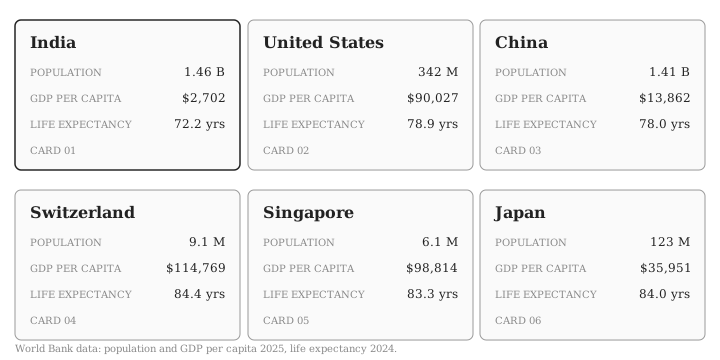
Everything is connected, of course - drinkable water, air, roads, all of it. But India is not a very rich country, and just like in any game with a finite set of resources and a finite number of turns, you have to optimize. Everyone may want a different problem solved first; but if we want to solve things as a country, the greater good has to win - pick the moves with the highest return for the nation given the resources and the stats we actually have. This is a start of the discourse I want to have - with whoever is listening - because without it, nothing above happens. And the clock, unlike in games, does not stop.