AI is essentially free
AI is essentially free. Not literally free - but close enough that the difference has stopped mattering for an individual. To see why, follow the tokens.
How much the usage grew.
OpenAI discloses API throughput occasionally. In November 2023, developers were pushing about 300 million tokens a minute through the API. By October 2025 it was more than 6 billion a minute. By March 2026, more than 15 billion a minute - roughly 21.6 trillion tokens a day. Anthropic has never disclosed token volume, but its annualized revenue went from about $1 billion in December 2024 to about $65 billion in July 2026, and third-party estimates put Claude at somewhere between 16 and 43 trillion tokens a day in mid-2026. One axis, one shape: vertical.
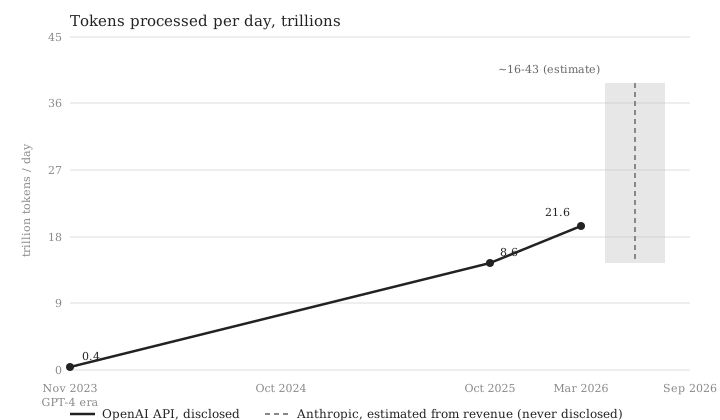
Caveats that matter: OpenAI’s figures are API-only and exclude the ChatGPT app; Anthropic’s range is an estimate derived from revenue, not a disclosure. Sources: OpenAI’s DevDay keynotes and its 2026 funding announcement (TechCrunch, OpenAI), Reuters on Anthropic revenue, the estimate via tokensperday.com and Epoch’s dataset.
Where the growth came from - and the bill.
A lot of those tokens were bought with a purpose. And a lot were not. AI was great, so leadership told everyone to use it even more. Companies set adoption targets and stood up internal leaderboards ranking employees by usage. So people started token maxing - burning tokens for the sake of the number, not caring what the API cost, because the company was paying. That is bad metrics, bad outcomes applied to an AI budget.
The stories are almost funny in retrospect. Uber pushed staff to use AI “as much as possible” with competitive leaderboards - and then its CTO revealed the company had burned its entire 2026 AI budget in four months. Uber now caps AI spending at $1,500 per employee per month, per tool (TechCrunch, June 2026; the COO publicly questioned whether the spend was worth it, per Fortune). At Meta, an employee built a dashboard called “Claudeonomics” that ranked 85,000-plus employees as AI users; over 30 days the company burned more than 60 trillion tokens, and the top user averaged 281 billion tokens a day - about $1.4 million a month at list prices. Meta shut the dashboard down two days after it was reported (Fortune, April 2026). Amazon staff ran internal AI agents on unnecessary tasks to hit weekly usage targets (Financial Times, May 2026) - and Amazon scrapped its usage leaderboard entirely. Microsoft started canceling most internal Claude Code licenses, in part to cut costs before its fiscal year end (The Verge, May 2026).
So companies curbed the spend, people grumbled, and the market found its level. Markets have cycles - more on that in the winner takes all post.
The cheap wave.
While the big providers were metering usage, the price of the intelligence itself collapsed. Take LiveBench (June 2026 release): the top of the board is Claude Fable 5.1 at 83.4 overall. DeepSeek V4.1 Flash sits at 81.1 - within 2.3 points - and actually leads the entire board on agentic coding at 77.3. Cost per task: $1.21 for the Fable, $0.029 for the Flash - about 3%. GLM-5.3 lands at 76.1 at $0.45 a task. Artificial Analysis tells the same story on its Intelligence Index: the frontier models lead, but the cheap tier is a few points behind, not a different universe.
In raw list prices per million tokens, as of September 2026:
| Model | Input | Output | Month at 100M in + 25M out | Year |
|---|---|---|---|---|
| GPT-6 Astra (OpenAI flagship) | $10.00 | $50.00 | $2,250 | $27,000 |
| Claude Opus 5 | $5.00 | $25.00 | $1,125 | $13,500 |
| GLM-5.3 | $1.40 | $4.40 | $250 | $3,000 |
| DeepSeek V4.1 Flash | $0.15-$0.30 | $0.60-$1.20 | $30-$60 | $360-$720 |
| GLM-5.3 Flash | $0.15 | $0.50 | $27.50 | $330 |
Sources: OpenAI’s GPT-6 Astra announcement, DeepSeek’s pricing page, VentureBeat on GLM-5.3 pricing and reporting on GLM-5.3-Flash. Put differently: o1 Pro cost $150 per million input tokens eighteen months ago; GLM-5.3 Flash costs $0.15 today. That is roughly a thousand-fold collapse in the price of a unit of intelligence.
What a developer actually spends, and the break-even.
Anthropic’s own Claude Code documentation puts typical usage at about $13 per developer per active day - $150 to $250 per developer per month in enterprise deployments. Jellyfish’s H1 2026 study of 135,000 developers found a median of $81 a month and a mean of $248; the 90th-percentile user consumes roughly 380 million tokens a month. Take that P90 power user and run the same workload on GLM-5.3 Flash: about $85 a month, roughly a thousand dollars a year. The break-even question - how much do you need to earn back in a year to cover your AI bill - has a new answer. On frontier models, a heavy user needs to justify $13,500 to $27,000 a year, a junior developer’s salary in some markets. On the cheap tier, they need to justify $330. That is one paying customer. One.
Which is exactly the economics behind one senior developer with agents doing the work of ten. The bottleneck used to be the cost of trying. Free is not the word. But compared to what the same performance cost two years ago, it might as well be.